🚀 AISafe Product Overview
AISafe is Maya Data Privacy's API-first de-identification engine. It strips PII from any API-connected workflow — AI/ML training pipelines, LLM prompts, data lake ingestion, ETL processes, test data provisioning, analytics — before data reaches a downstream system, and optionally restores it on the way back. It works in real-time and batch modes.
AISafe's anonymization is technically irreversible (patented in Europe and the USA) and meets GDPR Recital 26 requirements. Data processed through AISafe falls outside GDPR scope, which means you can use it for any purpose without needing consent or crossing organizational boundaries.
At a Glance
| Product type | API-first PII de-identification engine |
| Processing modes | Real-time and batch |
| Deployment | SaaS, On-premise, Private Cloud |
| Key regulations | GDPR, EU AI Act, DORA, HIPAA |
| Certifications | ISO 27001:2022, SOC 2 |
🔍 What is AISafe?
AISafe sits between your client applications and any downstream system. Before data reaches an LLM (OpenAI, Anthropic, Azure OpenAI, Mistral, Llama), a data lake, an ETL pipeline, or a testing environment, AISafe strips out the PII. Downstream systems never see real personal data.
AISafe is part of Maya's unified privacy platform alongside AppSafe (database anonymization) and FileSafe (file anonymization). When a customer ID is anonymized via AISafe, it maps to the same pseudonym across all three products. You get consistent identifiers across your whole landscape without maintaining a separate lookup table.
🏗️ Architecture Overview
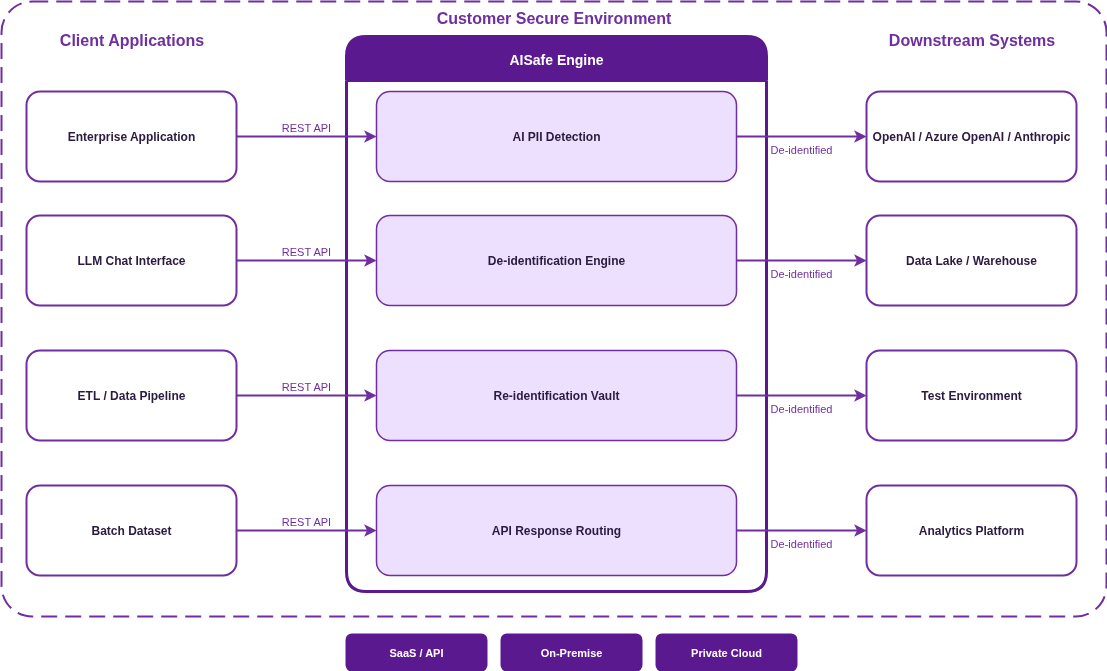
Key architectural principles
- API-first (REST, HTTPS, API key authentication)
- Containerized with Docker for on-premise and private cloud deployments
- Zero-storage: data is processed in-flight with no residual copies stored anywhere
- System-agnostic: works with any downstream system accessible via REST API
- Real-time and batch modes for different workload types
- No vendor lock-in: switch downstream providers without touching your privacy configuration
- Secure re-identification vault runs inside the customer's own environment
De-identification / re-identification process
- The client application sends data (prompt, document, dataset, or batch payload) to the AISafe API
- All indicated PII attributes are replaced with consistent pseudonyms. The mapping is held in-memory only, inside the client's secure environment
- De-identified data is returned as the API response (synchronous or asynchronous)
- For re-identification, AISafe swaps pseudonyms back to original identifiers within the customer's environment
- The client gets a fully contextual response, as if the downstream system had processed the real data
✨ Core Features
⚡ Processing modes
- Real-time — synchronous API calls for prompt-level and transactional de-identification
- Batch — asynchronous processing for large datasets, data lake ingestion, ETL pipelines, and test data provisioning
- Throughput and concurrency are configurable per deployment
🔎 PII detection using AI
- Detects PII in prompts, documents, datasets, structured data, and unstructured text
- Multilingual: German, English, French, and additional languages
- Covers names, addresses, IDs, phone numbers, emails, medical record numbers, financial identifiers, and more
- AI-driven field classification using RAG AI in an air-gapped environment
- Classification templates can be saved as Utility Sets and reused across databases and projects
- Manual intervention, audit, monitoring, and oversight are fully supported
🛡️ De-identification
- All PII is replaced with consistent pseudonyms before it reaches any downstream system
- The identifier mapping lives in-memory only, inside the client's secure environment
- Data distributions and correlations are preserved, so model quality and analytical accuracy stay intact
🔄 Re-identification
- Re-identification is available within the customer's secure environment
- The secure vault is not externally accessible
- Access controls govern when and how re-identification can occur
🔗 Cross-system consistency
- The same transformation is applied across databases, files, and API calls
- Referential integrity is maintained with AppSafe and FileSafe
- Zero-storage: no residual copies and no data surface that can be compromised
📋 Supported PII types
| No. | Data type | Detection | De-identification method | Re-identification |
|---|---|---|---|---|
| 1 | Names of people | AI-driven NER | Consistent replacement | Vault-based |
| 2 | Email addresses | Pattern + AI | Domain-preserving pseudonym | Vault-based |
| 3 | Phone numbers | Pattern detection | Format-preserving pseudonym | Vault-based |
| 4 | ID numbers (national, tax, etc.) | Pattern + context | Format-preserving pseudonym | Vault-based |
| 5 | Dates of birth | Context-aware | Date shifting / consistent dates | Vault-based |
| 6 | Addresses | AI-driven NER | Consistent location pseudonym | Vault-based |
| 7 | Medical record numbers | Pattern + context | Token replacement | Vault-based |
| 8 | Financial identifiers | Pattern detection | Format-preserving pseudonym | Vault-based |
| 9 | Custom / domain-specific PII | Configurable rules | Custom expression | Vault-based |
💡 Key use cases
AI startup: enterprise client data processing
An AI startup builds a product that processes enterprise client data via an LLM. The enterprise's legal team blocks the data flow because PII would reach a third-party model. AISafe de-identifies data before it reaches the LLM. Legal approves. The deal closes.
Enterprise internal GenAI deployment
A large enterprise wants to deploy ChatGPT or GPT-4 internally for HR queries, contract analysis, and financial reporting but cannot let PII leave the network. AISafe sits between the enterprise chat interface and the LLM API. Prompts are de-identified before leaving the network and re-identified on return.
Enterprise RAG: querying internal documents via LLM
An enterprise wants employees to query internal knowledge bases through an LLM-powered interface. AISafe de-identifies all PII in retrieved content before it reaches the LLM, so the model never processes real personal data.
Healthcare AI: medical data for ML models
A healthcare organization needs to train ML models on patient data without exposing patient identity. AISafe de-identifies patient records and clinical notes before they enter the training pipeline, covering both GDPR and HIPAA Safe Harbor requirements (18 identifiers).
Financial services AI: regulation-compliant analytics
A financial institution wants to use GenAI for risk analysis, fraud detection, or customer analytics but must meet DORA requirements on third-party ICT data exposure. AISafe removes that exposure: no PII reaches the external AI service.
Data lake ingestion: privacy-compliant data centralization
An enterprise consolidates data from multiple source systems into a central data lake. AISafe de-identifies PII in real-time or batch mode as data flows in via API. The lake holds only anonymized data — analysts and data scientists can access it freely without regulatory exposure.
ETL pipeline: secure data transformation
An organization runs ETL pipelines that extract data from production systems and load it into downstream environments. AISafe integrates into the ETL pipeline via API and de-identifies PII during the transformation stage. No personal data reaches non-production environments.
Test data provisioning: realistic non-production data
Development and QA teams need realistic test data that mirrors production but contains no real PII. AISafe de-identifies production data via API before it loads into test, development, or staging environments. Data structure, referential integrity, and statistical distributions are preserved.
⚡ Quick start
SaaS customers can make their first API call in minutes.
- Obtain your API key from the AISafe dashboard.
- Send a de-identification request:
curl -X POST https://api.mayadataprivacy.eu/aisafe/deidentify \
  -H "Authorization: Bearer <your-api-key>" \
  -H "Content-Type: application/json" \
  -d '{"text": "Contact John Smith at john@example.com"}'
- See the API reference for the full list of endpoints and parameters.
For on-premise and private cloud deployments, start with the local setup guide.
🚀 Deployment options
| Option | Description |
|---|---|
| SaaS / API | Internet connectivity to Maya API endpoint. Client makes REST API calls (HTTPS) with API key authentication. No specific hardware required. |
| On-premise | Docker containers deployed in the customer's data center. Runs in air-gapped environments with no cloud dependency. Full functionality inside the client perimeter. |
| Private cloud | Containers deployed in customer-controlled Azure, AWS, or GCP. Reference architectures available. |
AISafe addresses GDPR, EU AI Act, DORA, HIPAA, CCPA/CPRA, and DPDPA requirements. Maya Data Privacy holds ISO 27001:2022 (Sept 2025) and SOC 2 (Oct 2025) certifications.
⚙️ System requirements
On-premise / private cloud hardware
| Component | Minimum | Recommended |
|---|---|---|
| Operating system | Linux (RHEL, SLES, or equivalent) | Latest Docker-compatible Linux |
| CPU cores | 8 cores | 16 cores |
| Memory (RAM) | 32 GB | 64 GB |
| Disk | 128 GB | 128 GB+ |
| Software | Docker, Docker Compose (latest) | Docker, Docker Compose (latest) |
SaaS vs. on-premise requirements
| Requirement | SaaS | On-premise / private cloud |
|---|---|---|
| Connectivity | Internet (HTTPS to Maya API) | No internet required |
| Authentication | API key-based | Internal authentication |
| Infrastructure | No specific hardware | Docker-compatible Linux environment |
| Software | REST API capability | Docker, Docker Compose (latest) |